Ectopic Pregnancy – High-Yield MRCOG/MCPS Summary (NICE + RCOG Green-top Guideline)
This summary combines the key recommendations from NICE Ectopic Pregnancy and Miscarriage Guideline (NG126) and the RCOG Green-top Guideline on Tubal Ectopic Pregnancy, focusing on points commonly tested in exams.
—
Definition
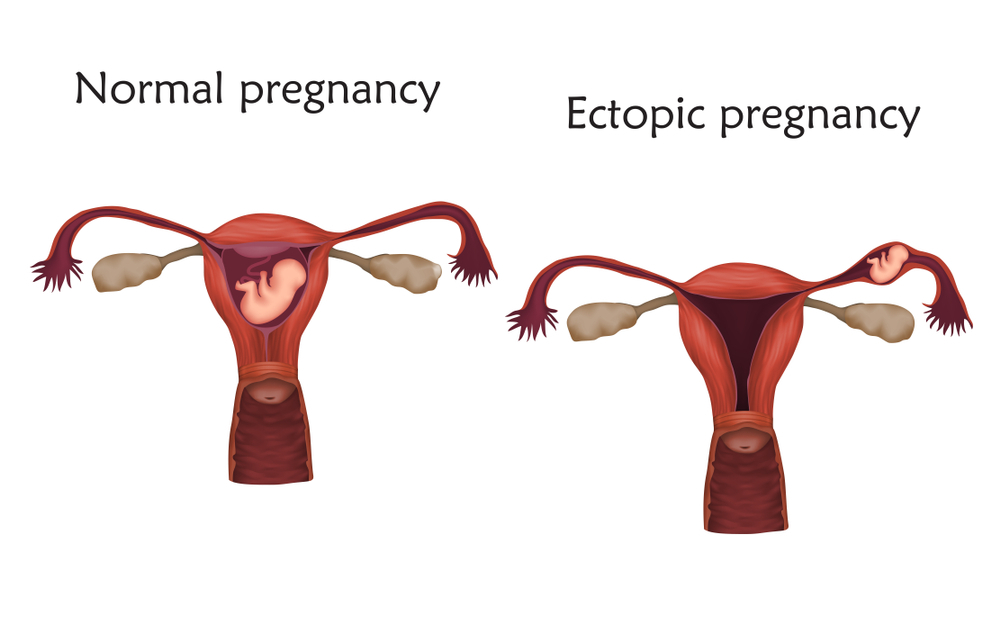
An ectopic pregnancy is implantation of a fertilized ovum outside the endometrial cavity.
Sites
Site Frequency
Ampulla of tube 70% (most common)
Isthmus 12%
Fimbria 11%
Interstitial (cornual) 2–4%
Ovary <3%
Cervix Rare
Caesarean scar Rare but increasing
Abdomen Very rare
Heterotopic pregnancy Rare naturally, ↑ after IVF
—
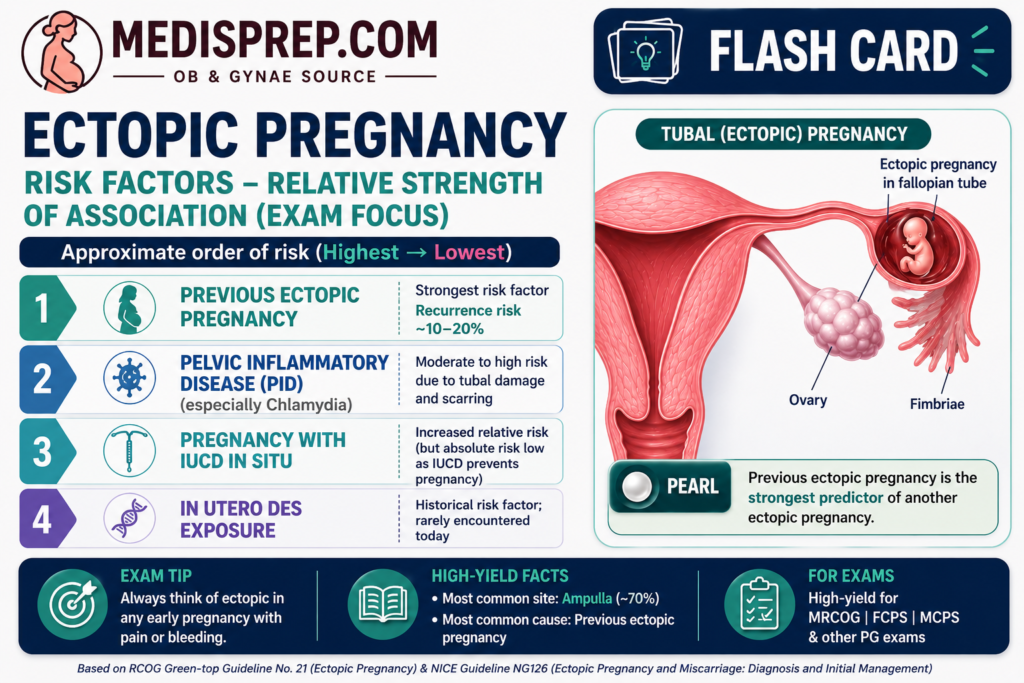
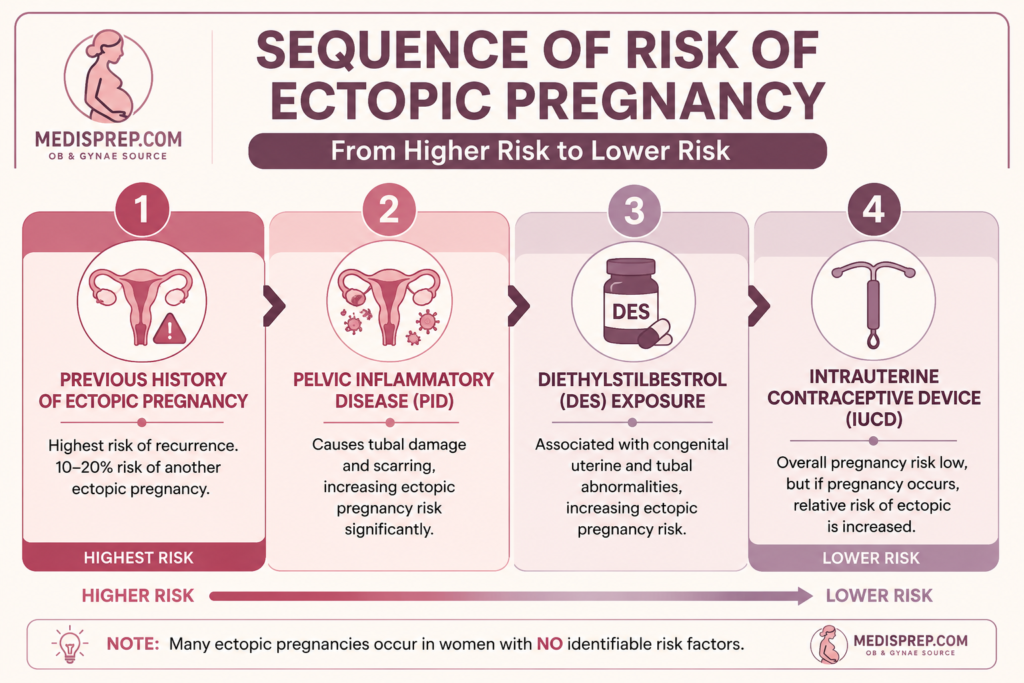
Risk Factors
Remember Previous Tubal Damage
High-risk factors
Previous ectopic pregnancy (10–20% recurrence)
Previous tubal surgery
Previous sterilization failure
Previous PID
Chlamydia infection
Assisted reproductive techniques (IVF)
IUCD in situ (overall pregnancy risk low, but if pregnancy occurs → relatively higher chance ectopic)
Endometriosis
Smoking
Increasing maternal age (>35)
Congenital tubal abnormalities
Remember
Half of ectopic pregnancies have NO identifiable risk factor.
Exam favorite.
—
Clinical Presentation
Classic triad
Amenorrhoea
Lower abdominal pain
Vaginal bleeding
Only about 50% present with all three.
—
Symptoms
Missed period
Positive pregnancy test
Unilateral pain
Vaginal spotting
Shoulder tip pain
Pain on defecation
Collapse
Syncope
Dizziness
—
Signs
Stable patient
Mild tenderness
Cervical excitation
Adnexal tenderness
Adnexal mass
Ruptured ectopic
Tachycardia
Hypotension
Pallor
Abdominal guarding
Rebound tenderness
Distension
Shock
—
Differential Diagnosis
Miscarriage
Corpus luteum cyst
Ovarian torsion
Appendicitis
PID
UTI
Renal colic
—
Initial Assessment
Always assess
ABCDE
First priority
Assess:
Airway
Breathing
Circulation
Disability
Exposure
—
Immediate Investigations
Pregnancy test
FBC
Blood group
Rh status
Crossmatch if unstable
Serum β-hCG
TVS
—
Serum β-hCG
Used
NOT to diagnose ectopic
Rather
To interpret ultrasound findings
and
Follow patients managed conservatively or medically.
—
Transvaginal Ultrasound (TVS)
Investigation of choice
Diagnostic findings
Definite ectopic
Extrauterine gestational sac
Yolk sac
Embryo ± cardiac activity
Suggestive findings
Adnexal mass
Tubal ring
Free pelvic fluid
Empty uterus
—
Pseudogestational sac
Exam favorite
Occurs inside uterus
BUT
Not a true gestational sac.
—
Pregnancy of Unknown Location (PUL)
Definition
Positive pregnancy test
BUT
No intrauterine or ectopic pregnancy seen on TVS.
Management
Repeat β-hCG after 48 hours
Repeat TVS
—
β-hCG Patterns
Normal viable pregnancy
Increase
≥63% in 48 hours (NICE)
Failing pregnancy
Falling β-hCG
Ectopic
Usually
Suboptimal rise
Plateau
or
Slow fall
Remember
β-hCG pattern ALONE
Cannot diagnose ectopic.
—
NICE hCG Follow-up
Repeat after 48 hours
Interpret trends together with ultrasound
Never rely on a single β-hCG.
—
Discriminatory Zone
Traditional
1500–2000 IU/L
BUT
NICE advises
Do NOT diagnose ectopic solely because β-hCG exceeds the discriminatory level and no intrauterine pregnancy is seen.
Repeat assessment.
Exam favorite.
—
Management Principles
Depends upon
Haemodynamic stability
Symptoms
β-hCG
Ultrasound findings
Patient preference
Follow-up reliability
—
Three Management Options
1. Expectant
2. Medical
3. Surgical
—
Expectant Management
Suitable if
Clinically stable
Minimal pain
Small ectopic
No fetal heartbeat
Falling β-hCG
Reliable follow-up
—
NICE criteria
Usually
β-hCG
<1000 IU/L
and already falling.
—
Follow-up
β-hCG
Twice weekly initially
Then weekly
Until
Negative
(<20 IU/L or local protocol)
—
Medical Management
Drug
Methotrexate
—
Mechanism
Folate antagonist
Stops trophoblastic proliferation.
—
Suitable when
Stable
No rupture
Minimal symptoms
Reliable follow-up
No contraindications
No fetal cardiac activity
Small ectopic
Usually
β-hCG
<1500 IU/L (NICE preferred)
RCOG notes success decreases as β-hCG rises; many centres use higher thresholds in selected patients.
—
Contraindications
Absolute
Breastfeeding
Immunodeficiency
Liver disease
Renal disease
Blood dyscrasia
Active lung disease
Peptic ulcer
Sensitivity to MTX
Ruptured ectopic
Haemodynamic instability
Relative
Large ectopic
Fetal heartbeat
High β-hCG
—
Dose
Single dose
50 mg/m² IM
—
Follow-up
Measure β-hCG
Day 4
Day 7
Expected
≥15% fall from Day 4 to Day 7
If achieved
Weekly β-hCG
Until negative.
—
If
Less than 15% fall
↓
Second dose
OR
Surgery
—
Advice After Methotrexate
Avoid
Pregnancy for 3 months
Alcohol
NSAIDs
Folic acid supplements
Heavy exercise
Sexual intercourse until symptoms settle
Seek help
If severe pain
Because rupture may still occur.
—
Surgical Management
Indications
Haemodynamic instability
Rupture
Contraindications to MTX
Failed MTX
Patient preference
Persistent pain
Large ectopic
Fetal cardiac activity
Unable to follow-up
—
Surgical Options
Salpingectomy
Removal of tube
Preferred
If opposite tube normal.
—
Salpingotomy
Tube preserved
Used when
Contralateral tube damaged
Future fertility important
—
Salpingotomy
Advantages
Preserves tube
Possible fertility benefit if opposite tube unhealthy.
Disadvantages
Persistent trophoblast
Need β-hCG follow-up
Repeat surgery possible
—
Persistent Trophoblast
Higher after
Salpingotomy
Requires
Weekly β-hCG
Until negative
May require methotrexate.
—
Laparoscopy vs Laparotomy
Stable
Laparoscopy
Gold standard
Unstable
Emergency laparotomy may be required.
—
Anti-D Immunoglobulin
Offer to
All RhD-negative women with a surgically managed ectopic pregnancy.
Routine anti-D is not required for women receiving methotrexate or expectant management unless there is another sensitising event or local policy indicates otherwise.
—
Interstitial (Cornual) Pregnancy
Higher mortality
Because rupture occurs late
Massive haemorrhage
Management
Specialist centre
Methotrexate in selected cases
Cornual resection
Occasionally hysterectomy
—
Caesarean Scar Pregnancy
Increasing incidence
Diagnosis
TVS
Management
Specialist MDT
Avoid curettage alone
Options include
Methotrexate
Local injection
Surgical excision
UAE with surgery in selected cases
—
Cervical Pregnancy
Massive bleeding risk
Treatment
Usually conservative
Methotrexate
Balloon tamponade
UAE
Surgery if needed
—
Ovarian Pregnancy
Rare
Usually diagnosed during surgery
Treatment
Ovarian wedge resection
—
Abdominal Pregnancy
Rare
Dangerous
Requires specialist management
Heterotopic Pregnancy
Simultaneous
Intrauterine pregnancy
Ectopic pregnancy
Higher after IVF
Important point
Seeing an intrauterine pregnancy does NOT completely exclude ectopic pregnancy in IVF patients.
—
Complications
Tubal rupture
Haemorrhage
Shock
Maternal death (rare)
Persistent trophoblast
Infertility
Recurrent ectopic
Adhesions
—
Future Fertility
Approximate recurrence
10%
After one ectopic
Risk increases after two.
Future intrauterine pregnancy rates are generally similar after salpingectomy and salpingotomy when the opposite tube is healthy.
—
Future Pregnancy Advice
Early pregnancy assessment
TVS at
6–7 weeks
to confirm intrauterine pregnancy.
—
Counseling
Explain
Risk of recurrence
Importance of early scan
Warning symptoms
Emotional support
Common MRCOG/MCPS/ FCPS Exam Pearls
✅ Ampulla is the commonest site (≈70%).
✅ Half of women have no risk factors.
✅ Shoulder-tip pain suggests haemoperitoneum due to diaphragmatic irritation.
✅ TVS is the first-line imaging test.
✅ A pregnancy of unknown location requires serial β-hCG and repeat TVS, not immediate treatment.
✅ A normal early intrauterine pregnancy should show a ≥63% rise in β-hCG over 48 hours.
✅ Do not diagnose ectopic based only on a single β-hCG level above the discriminatory zone.
✅ Methotrexate follow-up: Day 4 → Day 7 → ≥15% fall required.
✅ Salpingectomy is preferred when the contralateral tube is healthy.
✅ Salpingotomy requires serial β-hCG because of the risk of persistent trophoblast.
✅ Anti-D is recommended for RhD-negative women undergoing surgical management of ectopic pregnancy.
This covers the high-yield points from NICE NG126 and the RCOG Green-top Guideline on Tubal Ectopic Pregnancy most relevant for MRCOG Part 2, MRCOG Part 3, FCPS, and MCPS examinations.