6. CONTRACEPTION: COMPREHENSIVE GUIDELINES
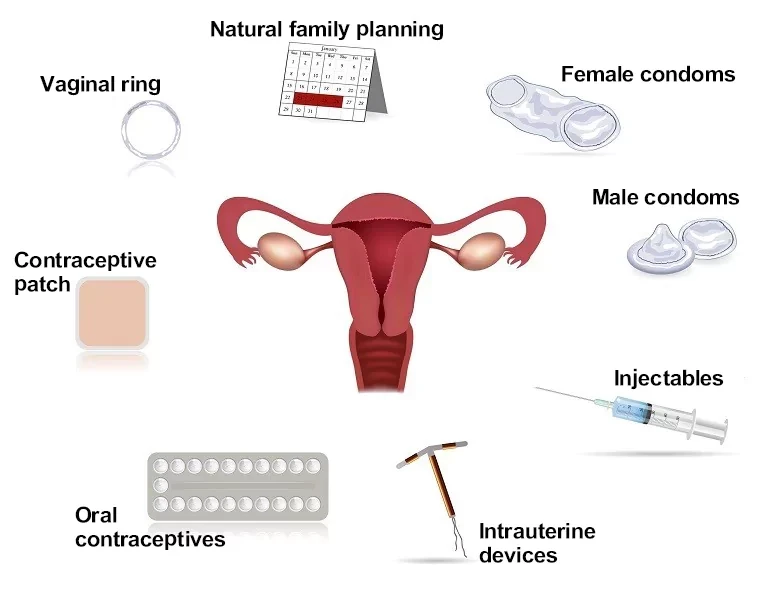
Core Principles & Counselling
The cornerstone of RCOG guidance is informed patient choice. Always advocate for Long-Acting Reversible Contraceptives (LARCs)—the IUS, IUD, implant, and injectable—as first-line options due to their superior typical-use efficacy. Utilise the UK Medical Eligibility Criteria (UKMEC) for all clinical decisions. Employ the “Quick Start” principle: initiate contraception immediately if it is reasonably certain the woman is not pregnant, without waiting for her next period.
Critical Drug Interactions
A vital exam topic is the management of patients on enzyme-inducing drugs (e.g., rifampicin/rifabutin, carbamazepine, phenytoin, St. John’s Wort). These drugs reduce the efficacy of all hormonal contraceptives, including the POP, CHC, and implant. Management requires using a reliable barrier method throughout the course of the enzyme-inducer and for a critical 28 days after stopping. For long-term therapy, consider a non-hormonal method like the copper IUD.
Combined Hormonal Contraception (CHC)
CHC (pill, patch, ring) is contraindicated (UKMEC 4) in women with a high risk of venous thromboembolism (VTE), including those with a personal history, major surgery with prolonged immobilisation, or migraine with aura. It is generally unsuitable (UKMEC 3) for women over 35 who smoke or have a BMI ≥35. For missed pills, advice depends on the number missed and the pill pack week; if there is any doubt, advise additional precautions.
Progestogen-Only Methods
Progestogen-only methods (POP, implant, injectable) are suitable for almost all women, including those with contraindications to estrogen. The desogestrel POP has a 12-hour missed pill window. Be aware that the injectable (DMPA) carries a UKMEC 2 for women with a history of depression and a UKMEC 3 for long-term use (>2 years) due to its potential impact on bone mineral density, though benefits often outweigh risks.
Intrauterine Contraception
The copper IUD provides immediate, non-hormonal protection for up to 10 years and is the most effective form of emergency contraception if inserted within 5 days of unprotected sexual intercourse. The Levonorgestrel-IUS (IUS) is a highly effective LARC for 5-8 years and is a first-line treatment for heavy menstrual bleeding. Both can be inserted immediately postpartum (within 48 hours) and post-abortion.
Postpartum and Post-Abortion Contraception
Contraception should be discussed antenatally and offered before discharge. Progestogen-only methods (POP, implant, injectable) can be started immediately after childbirth. The IUD/IUS can be inserted within 48 hours of delivery or deferred until 4 weeks postpartum. CHC should not be started until 21 days postpartum due to the high risk of VTE. Following abortion or miscarriage, any method can be started immediately on the day of the procedure.
Emergency Contraception (EC)
The most effective EC is the copper IUD, which can be used up to 5 days after UPSI and provides ongoing contraception. Ulipristal acetate (UPA) is more effective than Levonorgestrel EC, especially closer to ovulation, but should not be used by women already using regular hormonal contraception. Levonorgestrel EC is effective within 72 hours (with declining efficacy).
MRCOG/ Obs and Gynae Exam Pearls:
1. Core Philosophy: “LARC First”
Your first-line recommendation in any counselling scenario should be a Long-Acting Reversible Contraceptive (IUS, IUD, implant, injectable). You must be able to justify this based on their superior typical-use efficacy compared to user-dependent methods like pills.
2. The Golden Rule: Drug Interactions
This is a classic exam topic. Memorise the key enzyme-inducing drugs: Rifampicin/Rifabutin, Carbamazepine, Phenytoin, Topiramate, Modafinil, and St John’s Wort.
Management: With these drugs, all hormonal contraception (POP, CHC, implant, injectable) has reduced efficacy.
Use a barrier method throughout and for a critical 28 days after stopping the enzyme-inducer.
The best solution for long-term use is a non-hormonal method (Copper IUD).
3. UKMEC Classifications You Must Know
UKMEC 4 (Contraindicated):
CHC in women with migraine with aura, or at high risk of VTE (personal history, major surgery with immobilisation).
UKMEC 3 (Theoretical/Risks > Benefits):
CHC in women ≥ 35 years who smoke, or with BMI ≥ 35.
Injectable (DMPA) for long-term use (>2 years) in women with significant risk factors for osteoporosis.
UKMEC 2 (Advantages > Risks):
POP/Implant/IUS for most conditions where CHC is contraindicated (e.g., past VTE, migraine with aura).
4. Postpartum Contraception – Timing is Everything
Immediate (<48 hours): POP, Implant, Injectable. IUD/IUS can also be inserted immediately.
Delayed (≥ 4 weeks): IUD/IUS insertion if not done immediately.
Do NOT start until Day 21: CHC is contraindicated before 21 days postpartum due to high VTE risk.
5. Post-Abortion Contraception – Immediate Start
All methods can and should be started immediately on the day of the procedure. This is a key point for preventing rapid repeat unintended pregnancy.
6. Emergency Contraception – Know the Hierarchy
Most Effective: Copper IUD (up to 5 days post-UPSI). Offers ongoing contraception.
Next Best: Ulipristal Acetate (UPA) – more effective than Levonorgestrel, especially near ovulation. Crucially, it cannot be used with ongoing hormonal contraception.
Least Effective (of the three): Levonorgestrel EC.
7. Progestogen-Only Pill (POP) – Two Types
Distinguish between the traditional POP (3-hour missed-pill window) and the desogestrel POP (12-hour window). The desogestrel POP is more forgiving and more effective at suppressing ovulation.
By internalising these key points, you will be well-prepared to tackle contraception questions in the MRCOG exam. Remember the principles: Safety first (UKMEC), Efficacy first (LARC), and manage interactions decisively.